But I suppose, at some point my patient or impatient teachers must have instilled a bit of knowledge into me, and I do actually remember a few bouts of enthusiasm. Even then I quite enjoyed writing, and when I was about ten I remember writing this long, long story about a shipwreck which ended with the hero sinking slowly into the briny depths and describing everything on the way down. I didn't appreciate the impossibility of the situation even when it was pointed out to me. Nothing would persuade me to change my poetic ending.
I used to like art too, and knew I was good enough to achieve mostly quite interesting results, even though I didn't always adhere strictly to instructions. Coming in from lunch time and seeing all the tables spread with newspaper and with a sheet of grey sugarpaper in each place, was a joy for me. I suppose we must have had some sort of timetable, but we never knew it, so each lesson was a sort of surprise.
We listenened to radio programs for schools twice a week. One was a geography programme with a booklet full of shiny black and white photographs which accompanied the programmes. the booklet for the nature-study programmes was in colour. Even now I can still see a beautiful picture of a red squirrel on the front cover and remember the smell of that new shiny paper.
Much of the rest of the time was taken up with grappling with the complexities of arithmetic. Children in these decimalised days do not realise how easy they have it, compared to us grappling with the old Imperial measures. We became experts at adding up £5 . 17s . 11d and £1 . 19s . 4d
for example, bearing in mind, that there were twelve pennies (d) in a shilling (s) and twenty shillings in a pound. And pennies could be slit up into half pennies and quarter pennies (farthings) just to complicate matters further.
Our problems were far from solved even when we lhad finally learned to divide and multiply with money. The measures of weights and lengths were waiting in the wings. Everything was measured in feet and inches in those days. Our wooden rulers which we keptin our cardboard pencil boxes under our desks, were one foot, or twelve inches long. Thank goodness we never had to get seriously involved in chains and furlongs, except for horse-racing, and we were definitely not into that. But weights, (not mass please note) were important. We used to buy our sweets two ounces at a time, and there were sixteen ounces in a pound. I remember my grandmother's old scales. I used to love helping her weigh the ingredients for cakes or sponges. All her cast-iron weights could be fitted into one another, with the large pound weight at the bottom and the small half ounce weight at the top and the tray where the ingredients went was all bent from the time I used to sit in it as a tiny child.
The first time I came across kilos was when I was sixteen and having my first holidy abroad. We were rash enough to ask for a kilo of plums from an italian street vendor, which he duly supplied us with, in a flimsy brown paper bag. Needless to say, half the soggy plums fell out through the bottom of the bag before we could eat them. A kilo was far more than I had anticipated.
But back to imperial weights, our weight was recorded in stones and pounds. I remember when I was about nine, weighing five stone four pounds, and my grandmother saying that I was too thin. There were fourteen pounds in a stone, and coal was delivered in hundredweight (cwt) and twenty hundredweight made a ton.
So by the time we had got our heads round all these weights and measures, learned our tables off by heart right through till twelve, and mastered fractions and decimals as well, we had arrived at the top of the school and it was time to take the exam that everyone had to take in those days,the dreaded eleven plus.
There were three papers, Arithmetic, English and Intelligence. I remember quite enjoying myself once the initial terror had subsided. It was the first exam I had ever taken in my life, and we all sat in rows in the school hall, all eighty of us. I say about eighty, because there were about thirty-five of us in class one, over forty in class two, and a fair sprinkling of kids that had stayed languishing in lower classes.
Twelve of us passed including yours truly. The exam was taken in Januaryand the results came out in May. I and my friends were on our way to grammar school.
Thursday, 17 April 2008

Saturday, 12 April 2008
Junior School
I can see us now, a long crocodile of little girls all with woolly hats and swimming hats, setting out for the weekly trip to Hornsey swimming baths. I suppose swimming costumes and towels were pretty important too, but I don't remember anyone not being allowed to go for the lack of either of those two items. But it was back to lessons if we forgot either of our hats.
This was in our Junior school, a three-storey red-brick affair with Infants on the ground floor, Junior Boys on the first and us girls on the second. That wouldn't have been so bad except for the fact that the loos were downstairs, outside and right over the other side of the playground. We became experts at not only running up the many flights of shallow, concrete stairs two at a time, but also jumping down them two at a time as well, which required a certain amount of agility.
I don't think school halls have changed a great deal since those days. The strong smell of polish on their herring-bone patterned parquet floors still doesn't quite get rid of the more subtle undertones of disinfectant and saw dust. We had assembly every morning in the course of which we said the Lord's prayer and sang two real hymns, not the politically-correct nursery rhymes that kids are often subjected to today. The nine classes of little girls filed in crocodile fashion, arranging themselves lengthways down the hall, with the smallest in each class in front and the tallest at the back. I was always nearly at the back no matter which class I was in, starting in class eight and working my way through classes five and three until I achieved the dizzy heights of class one and I was at the top of the pile, so to speak.
I remember once, (I think I must have been in class three,) making an utter and absolute idiot of myself in assembly and coming out of that assembly hot with shame. We were asked who St Francis was and my hand shot up. I had been reading abook about Sir Francis Drake and thought I knew it all. 'He won the Spanish Armada' I said. Whoops! The whole school seemed to be laughing, although I am sure that the younger ones did not have a clue what they were laughing about, but I have never forgotten that particular assembly.
Handiwork was big on the agenda back then. They made sure we learned to sew and knit before we were eleven. I still have the handkerchief case which I made when I was eight or nine, painstakingly embroidered in coloured silks using at least half a dozen different stitches.
With knitting I was neither enthustiastic nor particularly talented. I remember, once we were making some sort of knitted ball thing, and how my triumph in almost coming to the end of the wretched thing turned into despair when a hole was discovered near the beginning and I had to undo most of it and start again. I never did finish that particular item. A year later we were making mittens, and having taken weeks to battle my way through the two inches of ribbing at the bottom, I smuggled my knitting home and let mother practically finish it for me.
I remember how old clever cuts in our class finished about eight items by the end of the year and I had barely finished two.
In the next class we made an embroidered bonnet in the winter months, and a check summer skirt later on. I must have been gradually improving as I finished bothe items and they were actually wearable.
These skills that I learned while I was young, no matter how reluctantly or imperfectly, have always been useful, and I find it sad that not more importance is attached to them nowadays in schools. My ten-year-old granddaughter for example, bright as a button in academic work and computers, hardly knew how to thread a needle until I taught her, let alone master the complexities of knitting.
Meanwhile, a floor below us, the boys would have been beavering away with their woodwork, which was also a useful skill that probably stood many of them in good stead later on in life.
We didn't see much of the boys. A prominent white line separated the two halves of the concrete playground. And at that age we were not particularly interested in going over it. They could keep their noise and their footballs to themselves as far as we were concerned. We had our own games.
Skipping featured prominently and with all the practice we had, most of us got very good at it. We used to have all sorts of rhymes and jingles that we used to skip to and they always used to end in dubs (short for doubles I suppose) when for every skip, the rope had to go under you twice, so you had to jump quite high, and you were truly exhausted if ever you got to fifty or above. I think the record was about ninety-two. The turners would be suffering from repetitive strain injury by this time as well.
We used to say and sing all sorts of rhymes as we juggled two balls against a wall. That was a game that amused us for hours, both at school and in the street. I haven't forgotten most of the complexities of the game even now, how we used to have to stand on one leg, juggle using just one hand, stand a long way away from the wall, turn around and still catch the ball. But when you dropped a ball you were out and it was the next person's turn.
Apart from the old standbys there were lots of games which seemed to come suddenly into fashion, but then, after a couple of weeks or a couple of months, fade into obscurity. A ball, preferably a heavy, rubber one, knotted into the end of a stocking was one such game. Within a week of its first appearance we we all standing with our backs to the wall bouncing the ball in the stocking behind us. The another time we would all be making collections of the tiny woollen bobbles that tend to appear on well-worn cardigans and jumpers. We would probably look a bit like a troupe of monkeys grooming one another for parasitic insects, as we swooped on yet another unfortunate victim with a particularly promising, colourful, bobbly jumper. Soon, that particular game had run its course, perhaps because the weather turned warm so the supply of woolly bobbles dried up.
In the summer, us girls were allowed to play in the 'field'. I have put that word in inverted commas because 'bomb-site' would have been the more apt description. The health and safely people of today would have literally had a field day! There were bricks and rubble everywhere, not piles of it, just thinly scattered, between which patches of clover and tufts of grass were bravely putting in an appearance. But that field was far more interesting than the one in my secondary school which was just covered with plain old grass, and gave rise to all sorts of interesting games. From the bits of bricks we would build houses, just one brick high I hasten to add. If you were lucky enough to get your hands on a whole brick, that would be a dressing-table. There were always plenty of bits of broken mirrors around to stand on top of the brick, probably glass too, but I never remember anyone falling and cutting themselves. We were a hardy lot, us post-war kids. There were daisies and a few dandelions too, so we could decorate our houses, as well as make daisy chains when the mood took us.
Then suddenly decorating houses was no longer the rage and we were all bringing wooden cotton reels to school, with four nails sticking out of the top. French knitting had come into fashion. I remember it was quite tricky getting started but once you were, and the round multicoloured snake of knitting began to emerge from the other end of the cotton reel it became great fun. The trouble was with french knitting was that you never really knew what to do with the increasingly lengthy coils, so you just kept on knitting until you had used up all the spare bits of wool that your mother was prepared to give you. By that time we had got a bit sick of it anyway.
Why is it that I remember so much more about games we used to play than my actual lessons. Probably that is why I never got a prize. Indeed, the only time I was called up onto the platform and given a clap was to collect my swimming certificates. The same theme went through all my junior school reports "Josephine does not try hard enough" But if they didn't pick me for their end of year plays because I was too tall to be a princess, and my hair was too long and curly to be the king, and I had to sit through hours of mind-numbing rehearsals of a play that I was not even in, until, in spite of myself, I knew the whole play off by heart, I didn't see why I should kill myself with work. so I just coasted along, played with my yo-yo under the desk and chewed my pencils until they resembled palm trees and I got splinters in my tongue.
This was in our Junior school, a three-storey red-brick affair with Infants on the ground floor, Junior Boys on the first and us girls on the second. That wouldn't have been so bad except for the fact that the loos were downstairs, outside and right over the other side of the playground. We became experts at not only running up the many flights of shallow, concrete stairs two at a time, but also jumping down them two at a time as well, which required a certain amount of agility.
I don't think school halls have changed a great deal since those days. The strong smell of polish on their herring-bone patterned parquet floors still doesn't quite get rid of the more subtle undertones of disinfectant and saw dust. We had assembly every morning in the course of which we said the Lord's prayer and sang two real hymns, not the politically-correct nursery rhymes that kids are often subjected to today. The nine classes of little girls filed in crocodile fashion, arranging themselves lengthways down the hall, with the smallest in each class in front and the tallest at the back. I was always nearly at the back no matter which class I was in, starting in class eight and working my way through classes five and three until I achieved the dizzy heights of class one and I was at the top of the pile, so to speak.
I remember once, (I think I must have been in class three,) making an utter and absolute idiot of myself in assembly and coming out of that assembly hot with shame. We were asked who St Francis was and my hand shot up. I had been reading abook about Sir Francis Drake and thought I knew it all. 'He won the Spanish Armada' I said. Whoops! The whole school seemed to be laughing, although I am sure that the younger ones did not have a clue what they were laughing about, but I have never forgotten that particular assembly.
Handiwork was big on the agenda back then. They made sure we learned to sew and knit before we were eleven. I still have the handkerchief case which I made when I was eight or nine, painstakingly embroidered in coloured silks using at least half a dozen different stitches.
With knitting I was neither enthustiastic nor particularly talented. I remember, once we were making some sort of knitted ball thing, and how my triumph in almost coming to the end of the wretched thing turned into despair when a hole was discovered near the beginning and I had to undo most of it and start again. I never did finish that particular item. A year later we were making mittens, and having taken weeks to battle my way through the two inches of ribbing at the bottom, I smuggled my knitting home and let mother practically finish it for me.
I remember how old clever cuts in our class finished about eight items by the end of the year and I had barely finished two.
In the next class we made an embroidered bonnet in the winter months, and a check summer skirt later on. I must have been gradually improving as I finished bothe items and they were actually wearable.
These skills that I learned while I was young, no matter how reluctantly or imperfectly, have always been useful, and I find it sad that not more importance is attached to them nowadays in schools. My ten-year-old granddaughter for example, bright as a button in academic work and computers, hardly knew how to thread a needle until I taught her, let alone master the complexities of knitting.
Meanwhile, a floor below us, the boys would have been beavering away with their woodwork, which was also a useful skill that probably stood many of them in good stead later on in life.
We didn't see much of the boys. A prominent white line separated the two halves of the concrete playground. And at that age we were not particularly interested in going over it. They could keep their noise and their footballs to themselves as far as we were concerned. We had our own games.
Skipping featured prominently and with all the practice we had, most of us got very good at it. We used to have all sorts of rhymes and jingles that we used to skip to and they always used to end in dubs (short for doubles I suppose) when for every skip, the rope had to go under you twice, so you had to jump quite high, and you were truly exhausted if ever you got to fifty or above. I think the record was about ninety-two. The turners would be suffering from repetitive strain injury by this time as well.
We used to say and sing all sorts of rhymes as we juggled two balls against a wall. That was a game that amused us for hours, both at school and in the street. I haven't forgotten most of the complexities of the game even now, how we used to have to stand on one leg, juggle using just one hand, stand a long way away from the wall, turn around and still catch the ball. But when you dropped a ball you were out and it was the next person's turn.
Apart from the old standbys there were lots of games which seemed to come suddenly into fashion, but then, after a couple of weeks or a couple of months, fade into obscurity. A ball, preferably a heavy, rubber one, knotted into the end of a stocking was one such game. Within a week of its first appearance we we all standing with our backs to the wall bouncing the ball in the stocking behind us. The another time we would all be making collections of the tiny woollen bobbles that tend to appear on well-worn cardigans and jumpers. We would probably look a bit like a troupe of monkeys grooming one another for parasitic insects, as we swooped on yet another unfortunate victim with a particularly promising, colourful, bobbly jumper. Soon, that particular game had run its course, perhaps because the weather turned warm so the supply of woolly bobbles dried up.
In the summer, us girls were allowed to play in the 'field'. I have put that word in inverted commas because 'bomb-site' would have been the more apt description. The health and safely people of today would have literally had a field day! There were bricks and rubble everywhere, not piles of it, just thinly scattered, between which patches of clover and tufts of grass were bravely putting in an appearance. But that field was far more interesting than the one in my secondary school which was just covered with plain old grass, and gave rise to all sorts of interesting games. From the bits of bricks we would build houses, just one brick high I hasten to add. If you were lucky enough to get your hands on a whole brick, that would be a dressing-table. There were always plenty of bits of broken mirrors around to stand on top of the brick, probably glass too, but I never remember anyone falling and cutting themselves. We were a hardy lot, us post-war kids. There were daisies and a few dandelions too, so we could decorate our houses, as well as make daisy chains when the mood took us.
Then suddenly decorating houses was no longer the rage and we were all bringing wooden cotton reels to school, with four nails sticking out of the top. French knitting had come into fashion. I remember it was quite tricky getting started but once you were, and the round multicoloured snake of knitting began to emerge from the other end of the cotton reel it became great fun. The trouble was with french knitting was that you never really knew what to do with the increasingly lengthy coils, so you just kept on knitting until you had used up all the spare bits of wool that your mother was prepared to give you. By that time we had got a bit sick of it anyway.
Why is it that I remember so much more about games we used to play than my actual lessons. Probably that is why I never got a prize. Indeed, the only time I was called up onto the platform and given a clap was to collect my swimming certificates. The same theme went through all my junior school reports "Josephine does not try hard enough" But if they didn't pick me for their end of year plays because I was too tall to be a princess, and my hair was too long and curly to be the king, and I had to sit through hours of mind-numbing rehearsals of a play that I was not even in, until, in spite of myself, I knew the whole play off by heart, I didn't see why I should kill myself with work. so I just coasted along, played with my yo-yo under the desk and chewed my pencils until they resembled palm trees and I got splinters in my tongue.
Friday, 11 April 2008
Swimming and Things
It is nearly a week since I have written anything and I believe I was talking about London Zoo. It was often a destination for birthday outings as I got older, when some long-suffering parent took their courage in both hands and marched half a dozen of us round the zoo. If they managed to return with the same number of kids that they started out with, the outing was deemed a success.
I remember once I 'fell' into the penguin enclosure, and another time an obliging relative of a friend of mine took us round the back of the aquarium where we could put our hands into the tanks and actually feed the fish. I think it was from that experience as well as seeing every Hans and Lotte Hass film that they ever made, that awakened my interest in Scuba diving, much, much later in life.
It certainly wasn't my early experiences of swimming that mustered any enthusiasm. Why was the open-air Lido in Gospel Oak always so cold? Even the sanitized footbath that you had to go through was toe-curling freezing. The pool itself was huge and blue. All that was missing were the ice-bergs floating in the water and getting in, going down the steps one at a time used to take every ounce of my will-power. The changing cubicles were even colder and more cheerless than the actual pool, and waiting at the counter to exchange a metal disc on a pin for your clothes and towel, was the coldest of all. Chattering teeth, blue arms and legs, and lifeless, dead white fingers and toes were all par for the course.
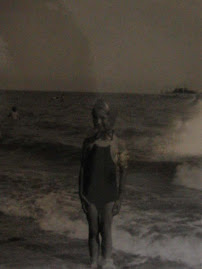
But there were some fun bits. I used to enjoy the freedom that my green water-wings gave me. Water-wings were the nineteen-fifties answer to arm-bands, and gave you the illusion of being able to swim, even when you couldn't really. Everyone had to wear swimming caps in those days. When I was very young I remember I had a soft plastic one that did up in a bow under my chin. I don't think it did a very good job of keeping the water out, but it was better than nothing. Later I progressed to the rubber ones which were murder to pull on and had a strap under the chin. But I wanted to talk about the fun bits, and pulling on rubber swimming hats definitely was not one of them. Bathing costumes were mostly knitted affairs, that pulled almost down to your knees when you emerged from the water.
The circular water cascade afforded a great deal of pleasure to unsupervised kids before it was fenced in. You could climb up each roaring white-water step, until you eventually got to the top, where you were mistress of all you surveyed, until the bath attendant yelled at you to come down of course. This of course was when I was older, old enough to go to the Lido willingly and voluntarily. But going with like-minded friends instead of parents made all the difference. We would practise jumping from the high diving board, and counting up to ten until we hit the water. We would throw things into to the deepest part. which was about nine feet, and dive to retrieve them. Yes, by the time I was ten I had practically grown fins.
It wasn't only the Lido we went to either. We patronised enthusiastically both Hornsey Baths in Holloway and Prince of Wales Baths. I remember, my mother and I went for an actual bath there once, and took our washing as well, but that was later, when times were really hard.
As for Hornsey, we used to go there on the bus with the school. I remember we used to fight for possession of the long streamer of forty or so tickets, but apart from that, we behaved ourselves. Being allowed to go swimming was a privilege that we did not wish to forfeit.
I don't remember actually learning to swim. I think it was a bit like learning to read. Suddenly I could do it without really having to go into the mechanics of the matter. So by the ageof eight I was the proud possesser of not only my fifty yards certificate,but my hundred as well, which meant that I had swum twice right round the pool without stopping.
When we went to Hornsey baths on our own, we were officially only allowed to stay in the water for half an hour, but if it was not very busy the attendant, a large kindly lady, would turn a blind eye and let us stay until our fingers turned wrinkly. (Washerwoman's fingers, my grandmother used to say.) There was a series of tiered platformsat the deep end from which we used to practise diving. I will never forget the sense of achievement when I managed to dive off the top one.
To sustain us for the mile and a half walk back we would buy a halfpenny's worth of broken biscuits at the baker's shop in Seven Sisters Road. I would still be starving by the time I arrived back home, and I remember with what acute enjoyment I used to polish off my favourite dinner of fried egg and chips.
It is difficult to know whether to follow each topic until I was a child no longer, or to proceed strictly chronologically. But that would mean that I would have to constantly keep on returning to topics. So now, bear with me. We have returned to London, my mother and I and I am thirteen. But still on the subject of swimming pools, it really is saving the best till last.
I found my mother muttering to herself one day 'I wonder if that Ladies' Pond in Kenwood is still open, where I used to go.' So we made a point of going to find it. We walked past the pond where I had fallen in as a child and later lost my toy yacht, past the men's pond, and then skirting Kenwood, another ten minutes' walk brought us to the notice which banned all males of our species. We walked up a short woodland path and arrived at a beautiful, tranquil pool. I can see it now in my mind's eye, glinting in the evening sunlight. Families of ducks seemed to have no objection to sharing their pond with humans, and continued to swim peacefully across the sparkling, greeny-brown surface, leaving hardly a ripple in their wake.
A concrete platform, very civilised changing cubicles and a series of cork rings fixed at intervals over the pond, distinguished it as a swimming area. But you had to be able to swim. There was no shallow end.
That summer I went there many times. My school was only about a mile's walk over the fields, so we used to go after school and sometimes when the days were long and light, even before, and then go into school assembly with dripping wet hair.
There is one little postscript to this. Years later when I was living in South Africa for a time, I met someone who subsequently became a very good friend of mine. We had both grown up in North London, that was coincidence enough, but what really bonded us, was that we both knew and loved the Kenwood Ladies Swimming Pool.
I remember once I 'fell' into the penguin enclosure, and another time an obliging relative of a friend of mine took us round the back of the aquarium where we could put our hands into the tanks and actually feed the fish. I think it was from that experience as well as seeing every Hans and Lotte Hass film that they ever made, that awakened my interest in Scuba diving, much, much later in life.
It certainly wasn't my early experiences of swimming that mustered any enthusiasm. Why was the open-air Lido in Gospel Oak always so cold? Even the sanitized footbath that you had to go through was toe-curling freezing. The pool itself was huge and blue. All that was missing were the ice-bergs floating in the water and getting in, going down the steps one at a time used to take every ounce of my will-power. The changing cubicles were even colder and more cheerless than the actual pool, and waiting at the counter to exchange a metal disc on a pin for your clothes and towel, was the coldest of all. Chattering teeth, blue arms and legs, and lifeless, dead white fingers and toes were all par for the course.
But there were some fun bits. I used to enjoy the freedom that my green water-wings gave me. Water-wings were the nineteen-fifties answer to arm-bands, and gave you the illusion of being able to swim, even when you couldn't really. Everyone had to wear swimming caps in those days. When I was very young I remember I had a soft plastic one that did up in a bow under my chin. I don't think it did a very good job of keeping the water out, but it was better than nothing. Later I progressed to the rubber ones which were murder to pull on and had a strap under the chin. But I wanted to talk about the fun bits, and pulling on rubber swimming hats definitely was not one of them. Bathing costumes were mostly knitted affairs, that pulled almost down to your knees when you emerged from the water.
The circular water cascade afforded a great deal of pleasure to unsupervised kids before it was fenced in. You could climb up each roaring white-water step, until you eventually got to the top, where you were mistress of all you surveyed, until the bath attendant yelled at you to come down of course. This of course was when I was older, old enough to go to the Lido willingly and voluntarily. But going with like-minded friends instead of parents made all the difference. We would practise jumping from the high diving board, and counting up to ten until we hit the water. We would throw things into to the deepest part. which was about nine feet, and dive to retrieve them. Yes, by the time I was ten I had practically grown fins.
It wasn't only the Lido we went to either. We patronised enthusiastically both Hornsey Baths in Holloway and Prince of Wales Baths. I remember, my mother and I went for an actual bath there once, and took our washing as well, but that was later, when times were really hard.
As for Hornsey, we used to go there on the bus with the school. I remember we used to fight for possession of the long streamer of forty or so tickets, but apart from that, we behaved ourselves. Being allowed to go swimming was a privilege that we did not wish to forfeit.
I don't remember actually learning to swim. I think it was a bit like learning to read. Suddenly I could do it without really having to go into the mechanics of the matter. So by the ageof eight I was the proud possesser of not only my fifty yards certificate,but my hundred as well, which meant that I had swum twice right round the pool without stopping.
When we went to Hornsey baths on our own, we were officially only allowed to stay in the water for half an hour, but if it was not very busy the attendant, a large kindly lady, would turn a blind eye and let us stay until our fingers turned wrinkly. (Washerwoman's fingers, my grandmother used to say.) There was a series of tiered platformsat the deep end from which we used to practise diving. I will never forget the sense of achievement when I managed to dive off the top one.
To sustain us for the mile and a half walk back we would buy a halfpenny's worth of broken biscuits at the baker's shop in Seven Sisters Road. I would still be starving by the time I arrived back home, and I remember with what acute enjoyment I used to polish off my favourite dinner of fried egg and chips.
It is difficult to know whether to follow each topic until I was a child no longer, or to proceed strictly chronologically. But that would mean that I would have to constantly keep on returning to topics. So now, bear with me. We have returned to London, my mother and I and I am thirteen. But still on the subject of swimming pools, it really is saving the best till last.
I found my mother muttering to herself one day 'I wonder if that Ladies' Pond in Kenwood is still open, where I used to go.' So we made a point of going to find it. We walked past the pond where I had fallen in as a child and later lost my toy yacht, past the men's pond, and then skirting Kenwood, another ten minutes' walk brought us to the notice which banned all males of our species. We walked up a short woodland path and arrived at a beautiful, tranquil pool. I can see it now in my mind's eye, glinting in the evening sunlight. Families of ducks seemed to have no objection to sharing their pond with humans, and continued to swim peacefully across the sparkling, greeny-brown surface, leaving hardly a ripple in their wake.
A concrete platform, very civilised changing cubicles and a series of cork rings fixed at intervals over the pond, distinguished it as a swimming area. But you had to be able to swim. There was no shallow end.
That summer I went there many times. My school was only about a mile's walk over the fields, so we used to go after school and sometimes when the days were long and light, even before, and then go into school assembly with dripping wet hair.
There is one little postscript to this. Years later when I was living in South Africa for a time, I met someone who subsequently became a very good friend of mine. We had both grown up in North London, that was coincidence enough, but what really bonded us, was that we both knew and loved the Kenwood Ladies Swimming Pool.
Thursday, 3 April 2008
A short pause
All I managed to do today was to post a couple of pictures on to this Blog. Now I am going to have a short holiday, where I might not have much opportunity to write much. But I will start again the middle of next week.
Wednesday, 2 April 2008
More Outings
We could rarely afford a visit to London Zoo, although it was so near to where we lived, that you could hear the wolves howling at night, when the wind was in the right direction. But what we often did, was to walk along the side of Regent's Park that abutted on to some of the enclosures. You couldn't get right up close, but either by peering through the double fence from the gravel path at the bottom, or by climbing up the grassy bank and looking into the enclosures from the top, you could make the acquaintance of not only the wolves, but all kinds of antelope and deer as well. It was not as good as going inside, but it wasn't bad for free.
Everything about the zoo was expensive, the entrance fee and even the large, orange ice lollies, which were the only ones they sold inside. They were sixpence, which was twice as much as what we normally paid for an ice.
Afternoon rides on the animals were not cheap either. Elephants had a row of three seats slung on either side of their broad, grey backs. The world looked different somehow from the top of an elephant, as the animal lumbered slowly round its circuit, lead by a keeper in a peaked hat. Rides on bactrian camels, the ones with two humps, were also very popular. I remember, as a small child being seated on the bendy neck of one of them, and thinking what fun it was as I sailed off, the camel's feet, as big as dinner-plates softly and patiently trudging round the well-known circuit. There were also rides for the more faint-hearted, but which I found rather tame. You could trot round in a little cart pulled by a llama and probably there were pony rides as well. Or were they in the Children's zoo? - that exclusive corner with unfortunately a prohibitively high entrance fee, where you could cuddle the animals. I only went in once, and I didn't find it as interesting as the elephants.
Bruno the baby brown bear was all the rage when I was young, rather like Knut in the Berlin zoo. I remember catching a glimpse of him from high in the terraces, but he was too far away to be interesting, and anyway, the crowds were so dense, that we soon left to find a quieter part of the zoo.
You were allowed to feed the animals in those days. People used to buy packets of monkey-nuts at the entrance or bring bread and things along with them. I remember trying to coax sleepy-eyed owls to sample the nuts I offered them, but they never took much notice. The monkeys were much more rewarding from that point of view.
I suppose my favourite was the reptile house. I used to like talking with the snakes. It was only much later that I found out that snakes are deaf , so my efforts at verbal communication were in vain. But I found the whole concept of deadly venomous bites absolutely fascinating. The more deadly the snake, the more I was held in thrall. On one occasion, when I was about five or six,
I had climbed over the barrier so that I was literally inches away from an extremely dangerous puff adder. I remember even now, how that huge snake followed my finger as I moved it up and down on one side of the thick glass, while he slithered up the other, showing his beautiful cream underbelly while doing so. It was a wonderful game, and evidently I gathered quite a crowd round me. But then my mother, who had been frantically looking for me, suddenly arrived on the scene, and ordered me in no uncertain terms to climb back over the barrier and behave myself. She was so cross that she didn't even give me a penny to throw on one of the crocodiles' backs, which people did, in a vain effort to get them to do something.
Zoos have come a long way since that time. I remember, even then feeling sorry for the lions, leopards and tigers as they padded endlessly around their small concrete-floored cages. And I remember the hippos, in their murky pool, just patiently waiting for people to throw food into their permanently gaping mouths. Someone threw a rubber ball in once, and killed the hippo. After that notices began to spring up everywhere. 'Do not feed these animals.' But the public continued to feed the elephants, long after that. The huge animals would teeter on the edge of the high side of the dry ditch which surrounded their enclosure, stretching out their trunks for buns and suchlike which the public loved to give them. But I think even that is stopped now.
Paintings of ancient elephant ancestors lined the rounded walls of the tunnels which lead under the Regent's Canal to the part of the zoo on the other side. I used to love being in these echoey caveman tunnels, and used to love looking at the pictures of mammoths, mastedons and sabre-tooth tigers.
All good things eventually come to an end, and the moment would arrive when we would approach one of the tall black-painted turnstiles marked 'Exit'. Most probably, we would be walking all the way home, a distance of about two miles. But the walk home did have its compensations. After a quick visit to the playground near our exit of Regent's Park, there was always the fountain to climb on. This was a bronze lady atop a heap of most inviting dark boulders. She was great fun.
Then of course, there was the pet shop half way down Park Way, with its adorable kittens, puppies or baby rabbits in the window. I was a bit older now and was beginning to understand the power of persuasive arguement. But it never seemed to work at the pet shop, and I never was the proud owner of one of those adorable bundles of fluff. "They are probably full of worms anyway." My mother would mutter under her breath as we made our way down to Camden Town.
There, we could have got a bus of course, but my mother used to say, "We're half way home now, so we might as well walk the rest." So walk we did. At least, by this time, I had found quite a good way to make her slow down. I would complain of stitch, bend over, and grab my side in pain. Sometimes it was genuine, but at other times, it was the merest twinge which I exaggerated like mad. I remember once I even negotiated a penny ice-lolly out of the situation. I was getting rather too good at it, and my mother was anxious that we got home before it got dark.
That night as i lay in bed, I listened for the woves howling in the distance, but it couldn't have been full moon. All I could hear, no matter how hard I listened, was the occasional swish of a car and the reassuring chimes of the Market Clock.
Everything about the zoo was expensive, the entrance fee and even the large, orange ice lollies, which were the only ones they sold inside. They were sixpence, which was twice as much as what we normally paid for an ice.
Afternoon rides on the animals were not cheap either. Elephants had a row of three seats slung on either side of their broad, grey backs. The world looked different somehow from the top of an elephant, as the animal lumbered slowly round its circuit, lead by a keeper in a peaked hat. Rides on bactrian camels, the ones with two humps, were also very popular. I remember, as a small child being seated on the bendy neck of one of them, and thinking what fun it was as I sailed off, the camel's feet, as big as dinner-plates softly and patiently trudging round the well-known circuit. There were also rides for the more faint-hearted, but which I found rather tame. You could trot round in a little cart pulled by a llama and probably there were pony rides as well. Or were they in the Children's zoo? - that exclusive corner with unfortunately a prohibitively high entrance fee, where you could cuddle the animals. I only went in once, and I didn't find it as interesting as the elephants.
Bruno the baby brown bear was all the rage when I was young, rather like Knut in the Berlin zoo. I remember catching a glimpse of him from high in the terraces, but he was too far away to be interesting, and anyway, the crowds were so dense, that we soon left to find a quieter part of the zoo.
You were allowed to feed the animals in those days. People used to buy packets of monkey-nuts at the entrance or bring bread and things along with them. I remember trying to coax sleepy-eyed owls to sample the nuts I offered them, but they never took much notice. The monkeys were much more rewarding from that point of view.
I suppose my favourite was the reptile house. I used to like talking with the snakes. It was only much later that I found out that snakes are deaf , so my efforts at verbal communication were in vain. But I found the whole concept of deadly venomous bites absolutely fascinating. The more deadly the snake, the more I was held in thrall. On one occasion, when I was about five or six,
I had climbed over the barrier so that I was literally inches away from an extremely dangerous puff adder. I remember even now, how that huge snake followed my finger as I moved it up and down on one side of the thick glass, while he slithered up the other, showing his beautiful cream underbelly while doing so. It was a wonderful game, and evidently I gathered quite a crowd round me. But then my mother, who had been frantically looking for me, suddenly arrived on the scene, and ordered me in no uncertain terms to climb back over the barrier and behave myself. She was so cross that she didn't even give me a penny to throw on one of the crocodiles' backs, which people did, in a vain effort to get them to do something.
Zoos have come a long way since that time. I remember, even then feeling sorry for the lions, leopards and tigers as they padded endlessly around their small concrete-floored cages. And I remember the hippos, in their murky pool, just patiently waiting for people to throw food into their permanently gaping mouths. Someone threw a rubber ball in once, and killed the hippo. After that notices began to spring up everywhere. 'Do not feed these animals.' But the public continued to feed the elephants, long after that. The huge animals would teeter on the edge of the high side of the dry ditch which surrounded their enclosure, stretching out their trunks for buns and suchlike which the public loved to give them. But I think even that is stopped now.
Paintings of ancient elephant ancestors lined the rounded walls of the tunnels which lead under the Regent's Canal to the part of the zoo on the other side. I used to love being in these echoey caveman tunnels, and used to love looking at the pictures of mammoths, mastedons and sabre-tooth tigers.
All good things eventually come to an end, and the moment would arrive when we would approach one of the tall black-painted turnstiles marked 'Exit'. Most probably, we would be walking all the way home, a distance of about two miles. But the walk home did have its compensations. After a quick visit to the playground near our exit of Regent's Park, there was always the fountain to climb on. This was a bronze lady atop a heap of most inviting dark boulders. She was great fun.
Then of course, there was the pet shop half way down Park Way, with its adorable kittens, puppies or baby rabbits in the window. I was a bit older now and was beginning to understand the power of persuasive arguement. But it never seemed to work at the pet shop, and I never was the proud owner of one of those adorable bundles of fluff. "They are probably full of worms anyway." My mother would mutter under her breath as we made our way down to Camden Town.
There, we could have got a bus of course, but my mother used to say, "We're half way home now, so we might as well walk the rest." So walk we did. At least, by this time, I had found quite a good way to make her slow down. I would complain of stitch, bend over, and grab my side in pain. Sometimes it was genuine, but at other times, it was the merest twinge which I exaggerated like mad. I remember once I even negotiated a penny ice-lolly out of the situation. I was getting rather too good at it, and my mother was anxious that we got home before it got dark.
That night as i lay in bed, I listened for the woves howling in the distance, but it couldn't have been full moon. All I could hear, no matter how hard I listened, was the occasional swish of a car and the reassuring chimes of the Market Clock.
Tuesday, 1 April 2008
Mainly Outings
To complete the saga of the carpet, I have to mention one last thing. Years later my aunt and uncle brought their vacuum cleaner along in the car, and proceeded to at last give that carpet a good clean. Three whole bagfuls of pure soot came out of it,and afterwards, it looked completelydifferent, a bit like the ceiling of the Sistine Chapel after its restoration in fact.
Now to get down to the title of this chapter. Living in more or less central London, wasn't a bad place to live from lots of points of view. But one misconception that I must put right for non-Londoners, is to point out that although we were only a few miles away from the West End, anywhere we wanted to go involved a lot of walking, and especially if one had a mother like mine, who would rather walk a mile than spend an extra penny on bus fares. It was a good ten-minutes walk to the nearest bus stop on Camden Road, and at least a mile to CamdenTown. It was even further to the shopping centre in the other direction, Holloway or the Nag's Head as my grandmother used to call it. Then of course, there was the endless Leyton Road leading to Kentish town. My mother often walked me all the way from Parliament Hill Field, up to the top of the hill and back, and then all the way home. It was a wonder that my legs were not worn down to stumps.
But I do remember travelling on the underground when I was still so small that the backs of my knees came nowhere near the edge of the seat making my feet stick out into the standing area, and when I still had the tendency to fall asleep on the way home. My mother would always take me out during the weekend. I remember, Kensington Gardens was one of my favourite places, with the Elfin Oak, (in those days not behind bars,) Peter Pan's statue and the Round Pond. And best of all there was big playground with lovely, but probably desperately unhygienic sandpits.
When I come to think of it, playgrounds in those days, were desperately dangerous all round, but they were probably much more fun. The solid child swings with an arrangement of pull-down bars probably weighed as much as the child that was put in it, and woe betide anyone who got hit by them! The ordinary swings were also made of solid wood, and there was just ordinary asphalt to land on if you fell.
Of the parks, I think Regent's Park was my favourite, with the 'Broad Walk' lined with huge banks of flowers and curly green-painted benches to sit on. Then, when I was older, I discovered the magic of 'Queen Mary's Gardens' or 'The Rose Gardens', as they were mostly called. Here was a magic bridge over the lake (which you could still go on in those days) leading to a, for me, enchanted island, where all manner or fascinating nooks and crannies could be found.
There was also in the Rose Gardens, a wonderful statue of writhing athletes, being attacked by huge snakes, with the water from the fountain, spouting dramatically all around them. This statue was surrounded by quiet benches and tall walls of ivy. My mother used to sit back on one of the benches and say "Who would think we were in the middle of London!" And indeed, there would be no-one there but us, and the only sounds to be heard would be the splashing of the fountain, birdsong and the gentle rustling of the ivy in the summer breeze. I do remember being the teeniest bit bored though, once I had circumnavigated the fountain, walking along its narrow wall, and not owning up to my sopping wet shoe and sock where I had nearly slipped in.
Something a little more tiresome, happened during one of our walks ove Parliament Hill Fields andGospel Oak. Where one ended and the other began, I was never quite sure. It was the same with Kenwood, which was also in that area. In the general direction of Kenwood are a series of ponds. They are the source of the Fleet River, which runs under Fleet Street and flows intothe Thames, so my mother used to tell me.She was always knowledgable about such things.
Two of the ponds had been turned into swimming pools, one for men and one for ladies. They exist still, and the ladies' one still has a very prominent notice 'No men beyond this point' A bit sexist for this day and age, but fun.
Anyway this pond where I was playing at about the age of three or so had a rather inviting tree, with a lovely, low branch jutting right out over the water. I couldn't resist, and soon I was clambering along it. I don't remember a great deal more except being hauled out of the pond by a very irate parent and a helpful passer-by. There was no danger involved, as the water was only knee deep near the bank, just mess, slimy green water weed and lots of mud.
But looking back,I realise how important these outings were for me. I grew up knowing not only how grass, flowers and trees looked, but how they smelt, what they sounded like when the wind blew or the rain fell, and how it felt to to lie flat on my back in the long wilder grass of Hampstead and Kenwood and see nothing but the sky and the clouds above, in short to have the privilege of knowing how it feels to be at one with nature during my earlychildhood when such impressions leave an indelible mark.
Now to get down to the title of this chapter. Living in more or less central London, wasn't a bad place to live from lots of points of view. But one misconception that I must put right for non-Londoners, is to point out that although we were only a few miles away from the West End, anywhere we wanted to go involved a lot of walking, and especially if one had a mother like mine, who would rather walk a mile than spend an extra penny on bus fares. It was a good ten-minutes walk to the nearest bus stop on Camden Road, and at least a mile to CamdenTown. It was even further to the shopping centre in the other direction, Holloway or the Nag's Head as my grandmother used to call it. Then of course, there was the endless Leyton Road leading to Kentish town. My mother often walked me all the way from Parliament Hill Field, up to the top of the hill and back, and then all the way home. It was a wonder that my legs were not worn down to stumps.
But I do remember travelling on the underground when I was still so small that the backs of my knees came nowhere near the edge of the seat making my feet stick out into the standing area, and when I still had the tendency to fall asleep on the way home. My mother would always take me out during the weekend. I remember, Kensington Gardens was one of my favourite places, with the Elfin Oak, (in those days not behind bars,) Peter Pan's statue and the Round Pond. And best of all there was big playground with lovely, but probably desperately unhygienic sandpits.
When I come to think of it, playgrounds in those days, were desperately dangerous all round, but they were probably much more fun. The solid child swings with an arrangement of pull-down bars probably weighed as much as the child that was put in it, and woe betide anyone who got hit by them! The ordinary swings were also made of solid wood, and there was just ordinary asphalt to land on if you fell.
Of the parks, I think Regent's Park was my favourite, with the 'Broad Walk' lined with huge banks of flowers and curly green-painted benches to sit on. Then, when I was older, I discovered the magic of 'Queen Mary's Gardens' or 'The Rose Gardens', as they were mostly called. Here was a magic bridge over the lake (which you could still go on in those days) leading to a, for me, enchanted island, where all manner or fascinating nooks and crannies could be found.
There was also in the Rose Gardens, a wonderful statue of writhing athletes, being attacked by huge snakes, with the water from the fountain, spouting dramatically all around them. This statue was surrounded by quiet benches and tall walls of ivy. My mother used to sit back on one of the benches and say "Who would think we were in the middle of London!" And indeed, there would be no-one there but us, and the only sounds to be heard would be the splashing of the fountain, birdsong and the gentle rustling of the ivy in the summer breeze. I do remember being the teeniest bit bored though, once I had circumnavigated the fountain, walking along its narrow wall, and not owning up to my sopping wet shoe and sock where I had nearly slipped in.
Something a little more tiresome, happened during one of our walks ove Parliament Hill Fields andGospel Oak. Where one ended and the other began, I was never quite sure. It was the same with Kenwood, which was also in that area. In the general direction of Kenwood are a series of ponds. They are the source of the Fleet River, which runs under Fleet Street and flows intothe Thames, so my mother used to tell me.She was always knowledgable about such things.
Two of the ponds had been turned into swimming pools, one for men and one for ladies. They exist still, and the ladies' one still has a very prominent notice 'No men beyond this point' A bit sexist for this day and age, but fun.
Anyway this pond where I was playing at about the age of three or so had a rather inviting tree, with a lovely, low branch jutting right out over the water. I couldn't resist, and soon I was clambering along it. I don't remember a great deal more except being hauled out of the pond by a very irate parent and a helpful passer-by. There was no danger involved, as the water was only knee deep near the bank, just mess, slimy green water weed and lots of mud.
But looking back,I realise how important these outings were for me. I grew up knowing not only how grass, flowers and trees looked, but how they smelt, what they sounded like when the wind blew or the rain fell, and how it felt to to lie flat on my back in the long wilder grass of Hampstead and Kenwood and see nothing but the sky and the clouds above, in short to have the privilege of knowing how it feels to be at one with nature during my earlychildhood when such impressions leave an indelible mark.
Fear
1.4.08
Even my dolls, sitting in an orderly row on the pink, brocade settee, assumed a rather sinister air in the half-light.
The very worst, was one night was when it had been raining, and my mother, without thinking anything about it, had hung her white mac up to dry on the upright handle of the carpet sweeper, which habitually stood just outside the dark, ominous cupboard. Never before or since, not even when charged by a rhino in South Africa, or had a cobra slung round my neck in Morocco, have I known what it feels like to have my hair stand on end. I did that night. I was too scared even to scream, not to mention get out of bed, and run through the dark passage way and the scullery to gain the safety of the kitchen. with sweat By the time they found me, hours later, I was still rigid with fear and my long flannelette nightie was quite damp with perspiration.
My vivid imagination was mostly my friend and my ally, indeed often the only source of entertainment and like-minded companionship that I had at my disposal. Through my imagination, my dolls and bears became alive. Each one not only had a name allotted to him or her, but a whole raft of personality traits as well. Most of them were not new. A largish bear and a rather politically incorrect doll called Topsy I inherited from my much older cousin. Topsy had little squiffs of black woollen hair poking out of three small holes in her dusky china skull, and Big Teddy had a rather more pointed face than is usual for bears of today. What remained of the fur on his tum, had to be brushed to the side on one side of his central seam, and straight down on the other. How is it that such trivial things are remembered for over half a century, whereas all sorts of much more important things are forgotten?
The linoleum, lino for short, in my grandmother’s bedroom cum general living room was of a blue colour with a vaguely ripply pattern on it. So I and my family of nine were able to take imaginary trips to the seaside whenever the fancy took us. I would adjust the clothing of all of them until I deemed it suitable for a bracing dip in the briny, and afterwards my grandmother would supply me with tea-towels to rub them all dry again. Then, with plastic dolls’ tea-set cups and teaspoons, we would dig in the sand. That probably did not do a great deal of good to the pile of the pinky-beige rug that was our improvised beach, but is was probably better than spilling a whole container of bubble liquid on to the big, sooty bedroom carpet.
It had been a pure accident, but I can see my mother and my aunt, even now, scrubbing away and remarking that they didn’t know where all the soap was coming from. The clean patch in that carpet was there for all to see, for months if not years afterwards. I could never look at it without at least a small twinge of guilt for giving everybody so much work and being the cause of my glamorous aunt getting down on her hands and knees and having a ladder in one of her new stockings. I wasn’t quite sure how she could have managed that. The ladders that I had seen leaning against the sides of houses would have been much too big. But they were all saying by this time, “Doesn’t that child ever stop asking questions?” So I had let the moment pass.
Two more points about that carpet, while we are on the subject. Firstly, that later on in life, eight or so, I found what an excellent way it was to shine up old pennies until they gleamed like new. I just had to rub them on the carpet until they were hot with friction. I used to love rubbing the Victorian pennies best, nearly as big as Ritz crackers, and worn quite flat from use. Yes, those were the days when there were 240 pennies in the pound, twelve in the shilling and twenty shillings to the pound. There were half-penny coins with a ship in full sail on the back, and farthing coins with a rather plump robin on the reverse. The silver three pence coins had already gone out of circulation. But my grandmother had a hoard of them in one of the copper containers on the mantelpiece (the stone shelf above the fireplace, for the uninitiated) She always meant to make a necklace out of them for me, but somehow, they disappeared before that little plan was ever realised. Silver sixpences were very much in circulation however, slightly larger than the 5p coins of today, they represented untold riches to me as a child. And each one I received as my weekly pocket money was buffed up with vigour until it shone and gleamed. It was a pity that I was too young to know about this after the accident with the soap bubbles, for I would have been able to quickly blend that accusing patch of clean carpet into the rest, with the aid of a handful of old pennies.
Even my dolls, sitting in an orderly row on the pink, brocade settee, assumed a rather sinister air in the half-light.
The very worst, was one night was when it had been raining, and my mother, without thinking anything about it, had hung her white mac up to dry on the upright handle of the carpet sweeper, which habitually stood just outside the dark, ominous cupboard. Never before or since, not even when charged by a rhino in South Africa, or had a cobra slung round my neck in Morocco, have I known what it feels like to have my hair stand on end. I did that night. I was too scared even to scream, not to mention get out of bed, and run through the dark passage way and the scullery to gain the safety of the kitchen. with sweat By the time they found me, hours later, I was still rigid with fear and my long flannelette nightie was quite damp with perspiration.
My vivid imagination was mostly my friend and my ally, indeed often the only source of entertainment and like-minded companionship that I had at my disposal. Through my imagination, my dolls and bears became alive. Each one not only had a name allotted to him or her, but a whole raft of personality traits as well. Most of them were not new. A largish bear and a rather politically incorrect doll called Topsy I inherited from my much older cousin. Topsy had little squiffs of black woollen hair poking out of three small holes in her dusky china skull, and Big Teddy had a rather more pointed face than is usual for bears of today. What remained of the fur on his tum, had to be brushed to the side on one side of his central seam, and straight down on the other. How is it that such trivial things are remembered for over half a century, whereas all sorts of much more important things are forgotten?
The linoleum, lino for short, in my grandmother’s bedroom cum general living room was of a blue colour with a vaguely ripply pattern on it. So I and my family of nine were able to take imaginary trips to the seaside whenever the fancy took us. I would adjust the clothing of all of them until I deemed it suitable for a bracing dip in the briny, and afterwards my grandmother would supply me with tea-towels to rub them all dry again. Then, with plastic dolls’ tea-set cups and teaspoons, we would dig in the sand. That probably did not do a great deal of good to the pile of the pinky-beige rug that was our improvised beach, but is was probably better than spilling a whole container of bubble liquid on to the big, sooty bedroom carpet.
It had been a pure accident, but I can see my mother and my aunt, even now, scrubbing away and remarking that they didn’t know where all the soap was coming from. The clean patch in that carpet was there for all to see, for months if not years afterwards. I could never look at it without at least a small twinge of guilt for giving everybody so much work and being the cause of my glamorous aunt getting down on her hands and knees and having a ladder in one of her new stockings. I wasn’t quite sure how she could have managed that. The ladders that I had seen leaning against the sides of houses would have been much too big. But they were all saying by this time, “Doesn’t that child ever stop asking questions?” So I had let the moment pass.
Two more points about that carpet, while we are on the subject. Firstly, that later on in life, eight or so, I found what an excellent way it was to shine up old pennies until they gleamed like new. I just had to rub them on the carpet until they were hot with friction. I used to love rubbing the Victorian pennies best, nearly as big as Ritz crackers, and worn quite flat from use. Yes, those were the days when there were 240 pennies in the pound, twelve in the shilling and twenty shillings to the pound. There were half-penny coins with a ship in full sail on the back, and farthing coins with a rather plump robin on the reverse. The silver three pence coins had already gone out of circulation. But my grandmother had a hoard of them in one of the copper containers on the mantelpiece (the stone shelf above the fireplace, for the uninitiated) She always meant to make a necklace out of them for me, but somehow, they disappeared before that little plan was ever realised. Silver sixpences were very much in circulation however, slightly larger than the 5p coins of today, they represented untold riches to me as a child. And each one I received as my weekly pocket money was buffed up with vigour until it shone and gleamed. It was a pity that I was too young to know about this after the accident with the soap bubbles, for I would have been able to quickly blend that accusing patch of clean carpet into the rest, with the aid of a handful of old pennies.
Subscribe to:
Posts (Atom)